
1.Field operations
- Employer
- A landscaping company in the Florida Keys. It is my family’s, not mine, so it is not mine to name here.
- Position
- Field-based3
- Duties
- Job site work, invoicing, accounts receivable
- Consequence
- The third duty is the origin of Section 2.
2.Software
2.1Premise
Software is built for field service crews, that is, for the same class of operation described in Section 1. The premise is stated plainly: the author is a user of the software before he is its author. Two systems are recorded. For each, three questions are answered in order: what problem, whose problem, and why it is unsolved.
2.2GroundCrew
- Problem
- A day ends without the owner knowing whether it ended.
- For whom
- An owner of two to twelve people, on a truck, not at a desk.
- Why open
- Existing systems assume a dispatcher in an office. There is none.
- Form
- One screen answers one question: does anything need me.
- Also
- Routing, job tracking, live map, customer notifications.
- Built with
- Swift, SwiftUI, Next.js, Firebase.
2.3Crew Talk
- Problem
- The sprinkler heads by the mailbox are broken. Said in the yard, to someone who speaks another language.
- For whom
- Any crew whose working language is split. In the Keys, common.
- Why open
- Consumer translators are built for a tourist ordering food. Wrong vocabulary, wrong hands, wrong light.
- Form
- One button. Speak, read, hand the phone over. It remembers the language, because an owner talks to the same crew every day.
- Built with
- Swift, SwiftUI.

GroundCrew
One screen that answers whether the day needs the owner, and a crew screen that shows the next house rather than a list of fourteen. A job is not finished until there is a photo of it, taken at the address.
Learn more about GroundCrew
- Built for
- An owner of two to twelve people, on a truck, not at a desk.
- Home screen
- Answers one question before anything else loads: does anything need me.
- Proof
- A job is not finished until there is a photo of it, taken at the address.
- Crew screen
- Shows the next house, not a list of fourteen.
- Platforms
- iOS for the truck, web for the desk.
- Why it matters
- Three weeks after a job, a customer says nobody came. Without a photo taken at the address that is one man’s word against another’s, and the owner loses it, because the customer is the one holding the cheque. With the photo the argument ends in four seconds. That is also why the invoice waits on the photo rather than on the crew: a job that cannot be proved is a job that cannot safely be billed, and the fastest way to make proof happen is to make it the thing standing between the crew and being finished.
- What it is doing
- Three jobs at once, and only the first one is obvious. It orders the route so a truck stops backtracking across the same neighbourhood. It holds the checklist for each property, so what that customer pays for is what actually gets done. It collects the proof, so the invoice can leave the same day instead of waiting on somebody’s memory.
- What it is worth, estimated
- No week has been measured yet, so the figure below is arithmetic rather than a result. Every input is printed so a reader can disagree with one and redo it.7
The point of the figure is not the total. It is the shape: the time is worth roughly three times the fuel, and the fuel is the only one of the two that arrives with a receipt, which is why it is the only one anybody counts. Neither is the biggest number on the page. That one is the invoice that never went out because nobody could prove the work.
Input Assumed Trucks 3, five days a week Miles per truck per day, route built by hand 60 Miles removed by ordering the route 15% Fuel 12 mpg towing, $3.50 a gallon Average speed, island driving with stops 25 mph Crew cost while driving $22 an hour per truck - Built with
- Swift, SwiftUI, Firebase, Next.js.
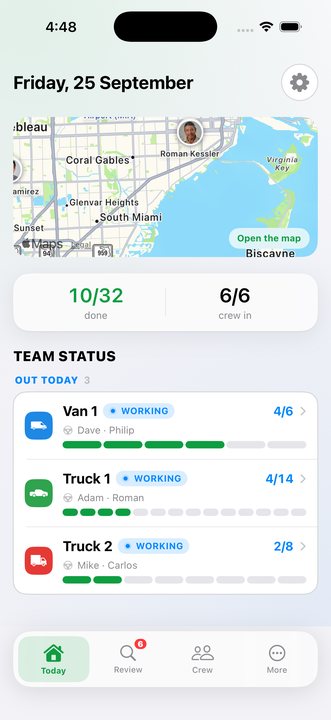
img/gc-today.jpg1a. Owner, morning. Where every truck is, how much of the day is done, who turned up.
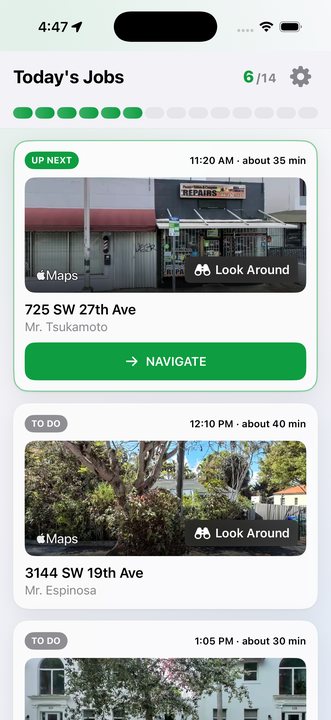
img/gc-worker.jpg1b. Crew. The next address, and one button to drive there. Not a list of fourteen.
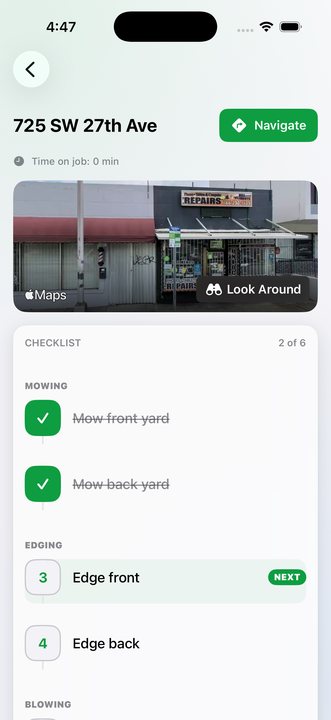
img/gc-checklist.jpg1c. At the property. The checklist for that address, grouped, in order.
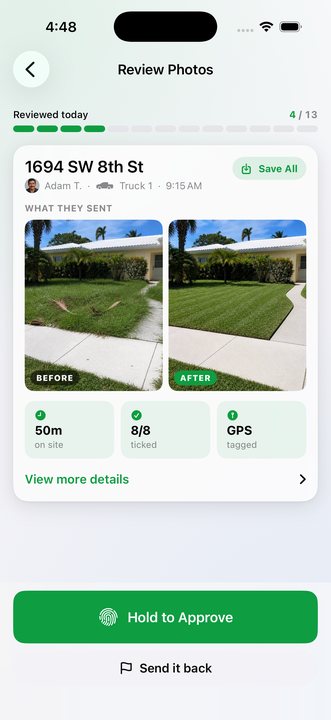
img/gc-proof.jpg1d. The proof. Before, after, minutes on site, GPS tagged. A job is not finished without it.
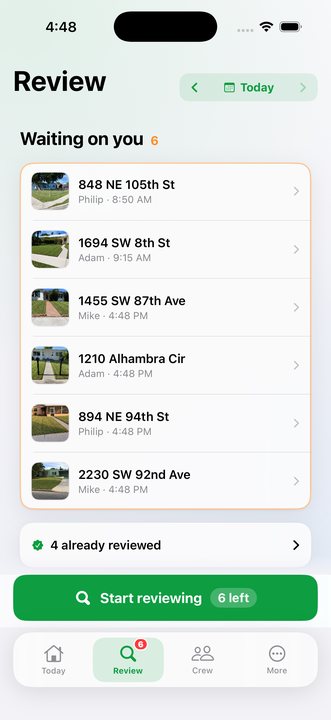
img/gc-review.jpg1e. Back to the owner. Finished jobs queued for a yes or a no, and then the invoice.

Crew Talk
A live two-way translator for a job site. It tidies the sentence before it translates it, drops the filler and the false starts, then says it the way a working crew actually says it rather than the way a textbook does. Consumer translators are built for a tourist ordering food.
Learn more about Crew Talk
- Problem
- The sprinkler heads by the mailbox are broken. Said in the yard, at speed, with no typing.
- For whom
- Any crew whose working language is split. In the Keys, common.
- Why open
- Consumer translators optimise for breadth of vocabulary. This needs the opposite: a narrow vocabulary, spoken aloud, read at arm's length, in sunlight.
- Form
- One button. Speak, read, hand the phone over.
- Before translating
- The raw transcript is cleaned on the phone first: filler, false starts and misheard trade words. Nothing leaves the device for that step.
- The rule it is given
- Translate meaning, not words. Match the speaker’s tone. Use the word the trade uses, never the dictionary one. Never round a number.
- Why it is spoken, not typed
- The sentence in Plate 2c is twelve words. Said out loud at ordinary speaking pace it takes about five seconds. Typed on a phone keyboard at the rate people actually manage, about nineteen. Stanford measured the same gap directly: speech entry ran 3.0× faster than typing with 20.4% fewer errors.6 Nineteen seconds is the optimistic number, because it is the time to type the sentence in English. It does not include translating it, and it assumes bare hands. On a job site the hands are in gloves, the screen is in full sun, and the other man is already walking away. That is the whole case for the app: the gap is not convenience, it is whether the sentence gets said at all.
- Built with
- Swift, SwiftUI.
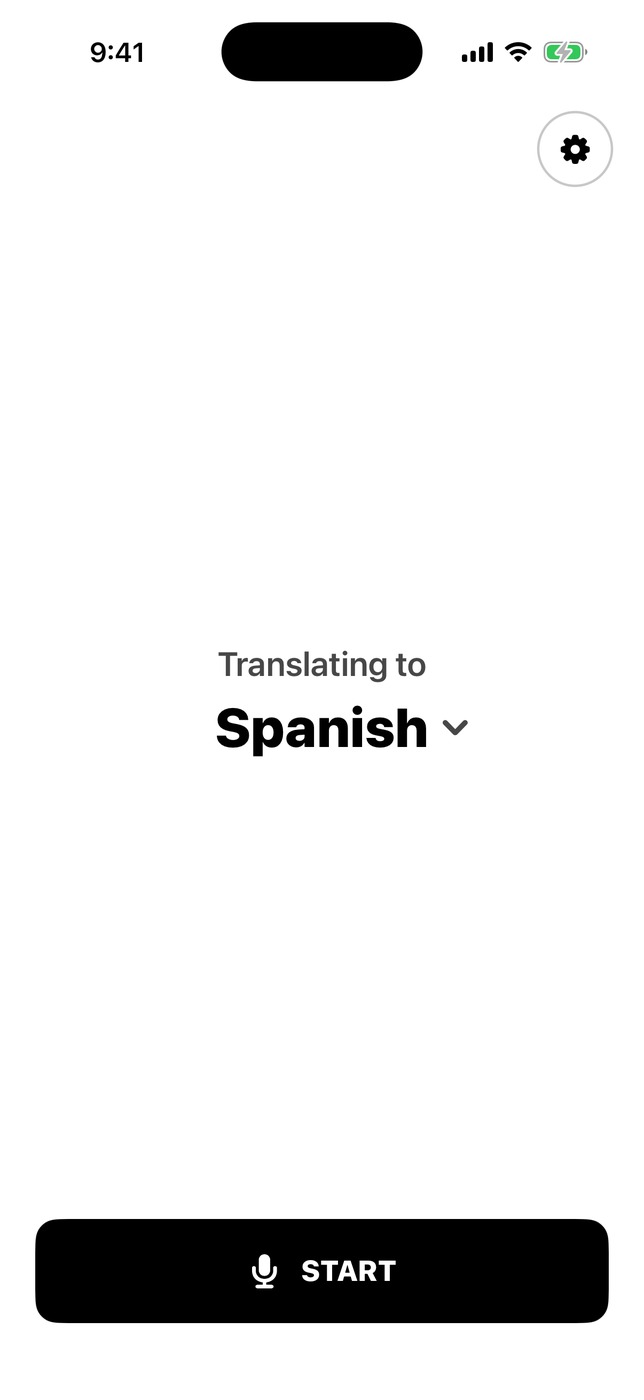
img/ct-home.jpg2a. Idle. The whole interface is the language and one button. It remembers who you talk to.
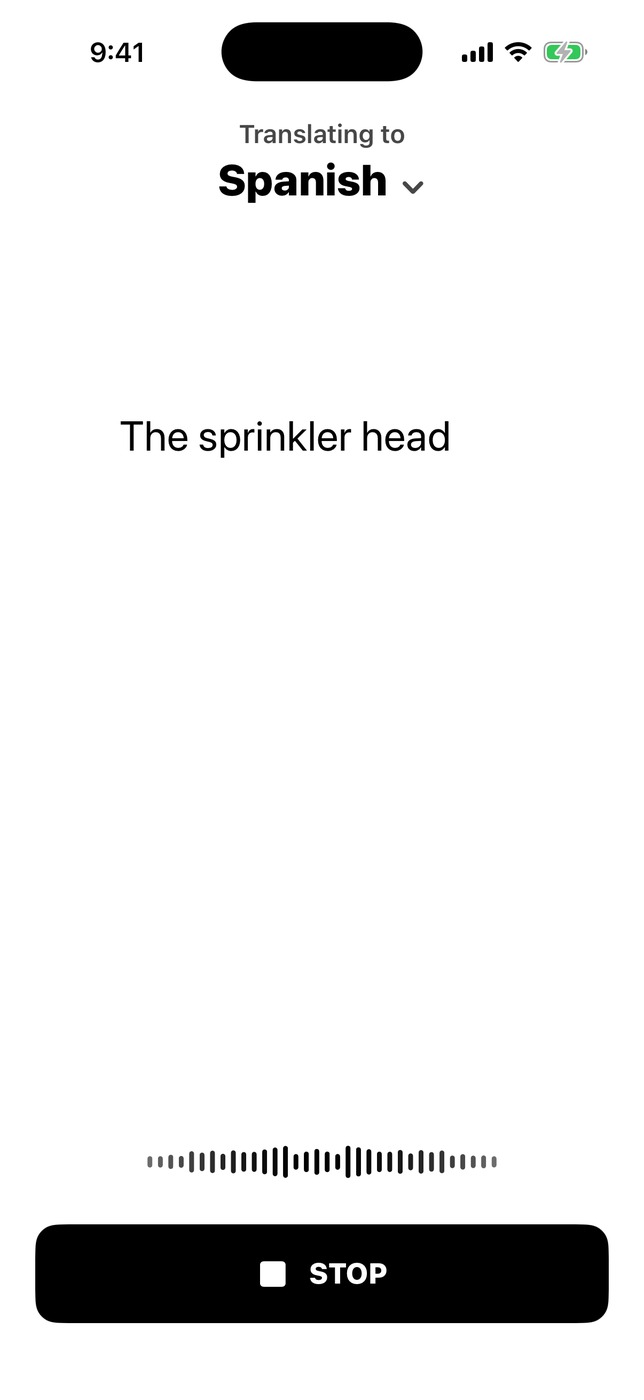
img/ct-listening.jpg2b. Listening. English arrives word by word while it is still being said. No keyboard, ever.
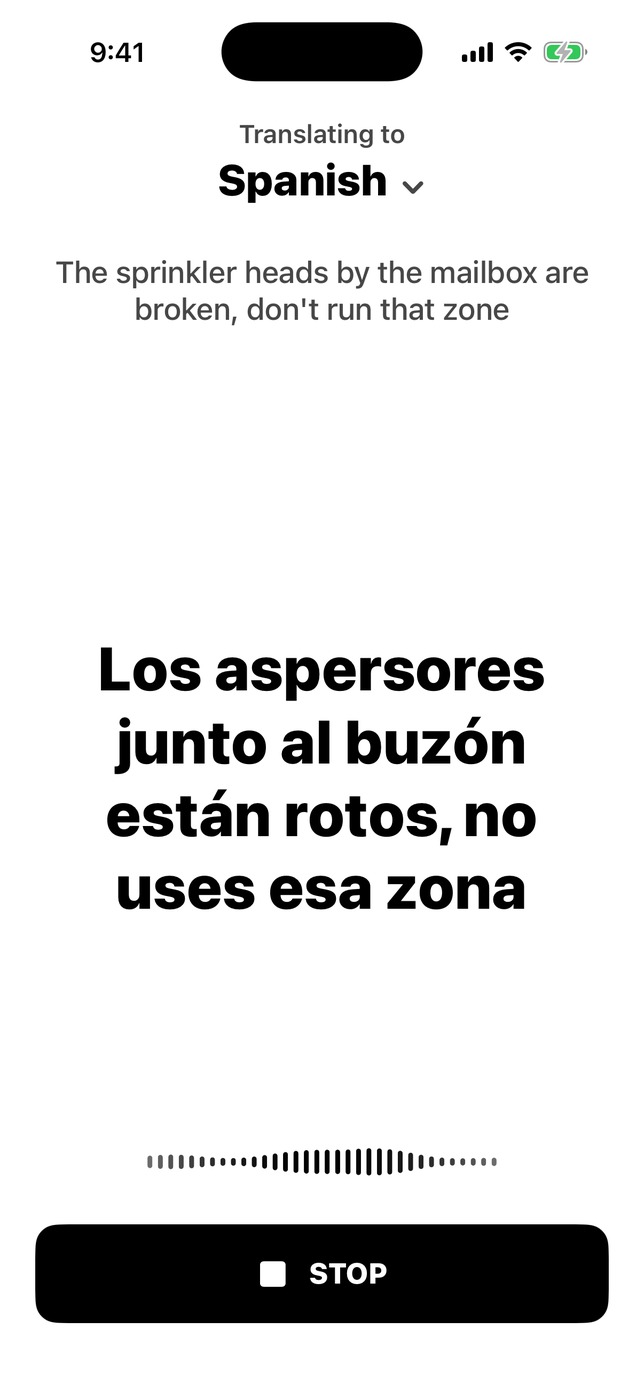
img/crewtalk.jpg2c. The answer, in type you can read at arm’s length across a yard.
3.Method
3.1Compiled research
A private reference library is maintained, compiled from primary sources rather than summaries. It is the instrument used to decide what is built and how it is sold. Two components are recorded here.5
3.2Instrument I: the feeling model
Products are selected by the feeling they resolve rather than by the function they perform. The model pairs a pressure, the condition that makes a person act now, with a payoff, the condition they are left in afterwards. Twelve payoffs and eight pressures are catalogued. Nine pairings are recorded as functional and four as broken. Each candidate is scored out of four on urgency, recurrence, privacy and shareability before any construction begins.
3.3Instrument II: the counting rule
One hundred operator case histories are held, sorted by practice rather than by person. A practice observed in fifteen or more cases is recorded as a law; five to fourteen as a pattern; fewer than five as a one-off, which is to say luck. Every entry carries a counter-case. The rule exists to suppress survivorship bias, which is the error of studying only the survivors.
- Select the feeling before selecting the product.
- Score it out of four. Below two, it is a hobby.
- Check the count. If fewer than five operators did it, it is not evidence.
- State the counter-case aloud before proceeding.
- Build the smallest testable form, then look at what happened rather than at what was expected.
3.4Instrument III: the named rules
Forty-odd rules are held under the counting discipline in 3.3. Three are reproduced here as a sample of what is in the file. All three concern what a person’s brain does before they know they have decided anything, and each carries a case against itself.
- The Buying Brain
- A purchase is one subtraction: want minus pain. Stanford put people in a scanner in 2007, showed them a product, then the price, then a yes or no button, with real money. Three regions did the work. One made the object glow. One registered a price as physical pain, in the same place the brain files disgust. A third settled the difference. The scan predicted the purchase before the button was pressed, and it beat what the person said about themselves.
Where it breaks: almost everybody selling works only on the want half. They build a good pitch and then let the price hurt, and lose it in the last three seconds. Dopamine is wanting, not enjoying, which is also why the thing is less interesting once it is owned. - The Should Price
- Nobody checks a price. They check the gap between it and the number already sitting in their head. Ninety thousand dollars for a car is fine and nine dollars for a bottle of water is an insult, same wallet, same afternoon. The man who buys the car will circle the block twice to dodge a paid space, and that is not greed; he has no fixed number for a car and a very hard one for parking.
Where it breaks: it only bites where a should price exists. The work with no fixed number in the customer’s head is where the margin is, and it is also the work that is hardest to sell. - Stop At Two
- Say two facts that are true and checkable and that only add up one way, then stop. The listener says the third thing out loud, and a person does not argue with himself. Last cut was March. It is September. Nobody was told anything. Aristotle called the gap an enthymeme and the name is two thousand years old, which is a long time for a trick to keep working.
Where it breaks: only in a live room, with one person who can answer back. A crowd reading a page will not do the work of filling the gap; they scroll. In one-way writing, the message that states its conclusion beats the message that leaves it hanging, so nothing on this page is doing it.
4.Certifications
Nine certifications are held. Issuing bodies number eight. The earliest issue date is March 2023; the most recent is September 2026. Five were obtained before the age of 18. Two are certifications of the State of Florida, entries 1 and 3. Entry 2 is the training Florida statute requires before entry 1 can be issued. Entry 3 is the one that trains you to keep a stranger talking until the ambulance gets there. Expiry is recorded only where stated by the issuing body.4
Table 1. Certifications held, ordered by issue date, descending. n = 9. One expiry field is withheld until selected. A plate is reproduced below for every entry.
| # | Certification | Issuing body | Issued | Expiry | Certificate |
|---|---|---|---|---|---|
| 1 | Limited Urban Commercial Fertilizer Applicator no. LF502750 | Florida Department of Agriculture and Consumer Services | Sept 2026 | Sept 2030 | |
| 2 | Green Industries Best Management Practices (GI‑BMP) | University of Florida IFAS Extension | Sept 2026 | not stated | |
| 3 | 911 Public Safety Telecommunicator (state certification) | Florida Department of Health | May 2026 | Feb 2027 | |
| 4 | Basic Life Support: CPR and First Aid | Divers Alert Network | May 2026 | May 2028 | |
| 5 | Certified Food Safety Manager | National Registry of Food Safety Professionals | Apr 2024 | Apr 2029 | |
| 6 | Master Certification in Entrepreneurship | Certiport | May 2023 | May 2028 | |
| 7 | Intuit Design for Delight Innovator | Intuit | May 2023 | not stated | |
| 8 | Adobe Certified Professional, Visual Design Using Photoshop | Adobe | May 2023 | ||
| 9 | Entrepreneurship and Small Business (ESB) | Certiport | Mar 2023 | May 2028 |
View all certificates9 plates
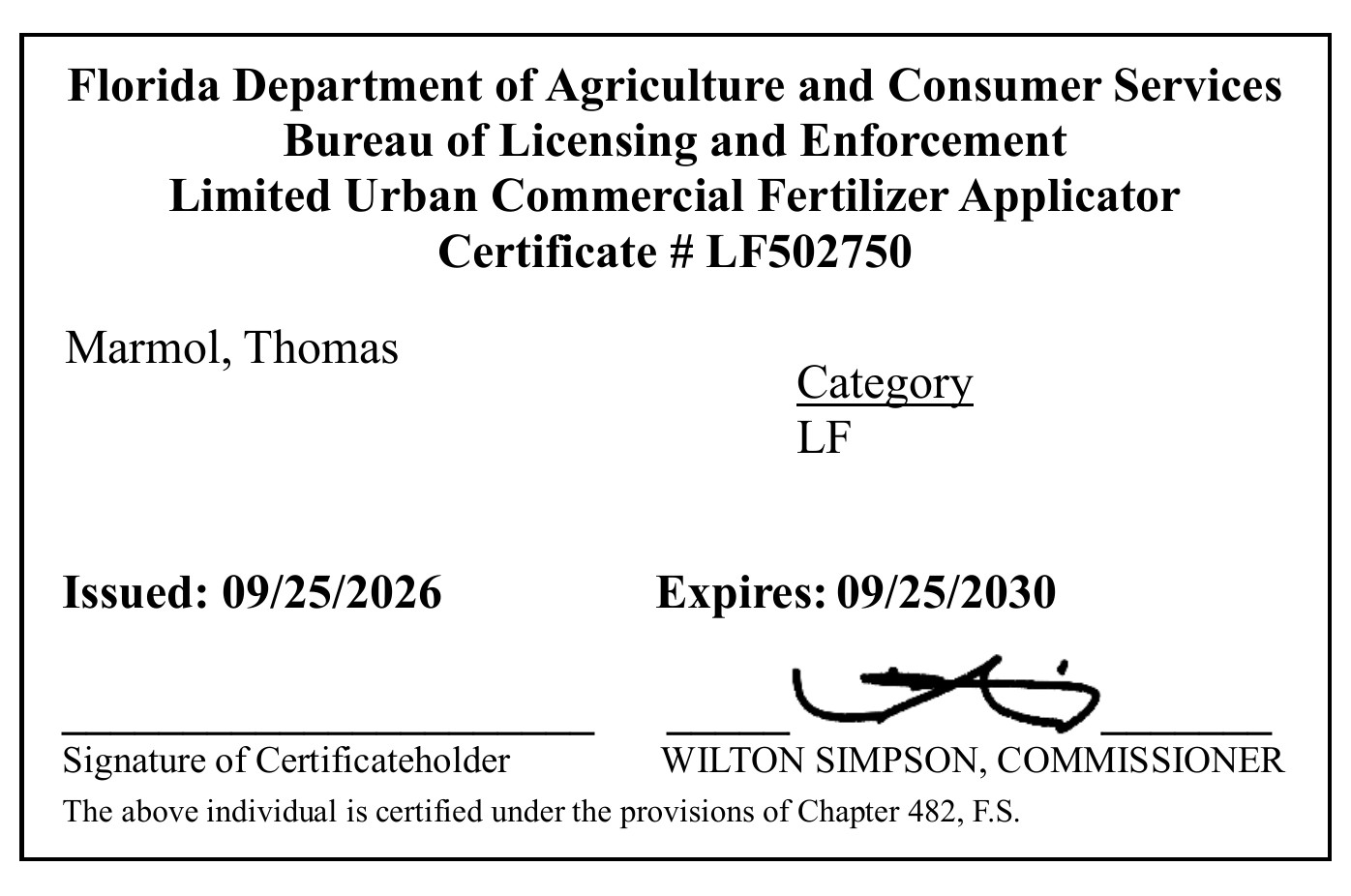
img/cert-fertilizer.jpgLimited Urban Commercial Fertilizer Applicator. Florida Department of Agriculture and Consumer Services · Sept 2026 · no. LF502750 · Chapter 482, F.S.

img/cert-gibmp.jpgGreen Industries Best Management Practices. University of Florida IFAS Extension · Sept 2026 · no. GV936745-1

img/cert-911.jpg911 Public Safety Telecommunicator. Florida Department of Health · May 2026
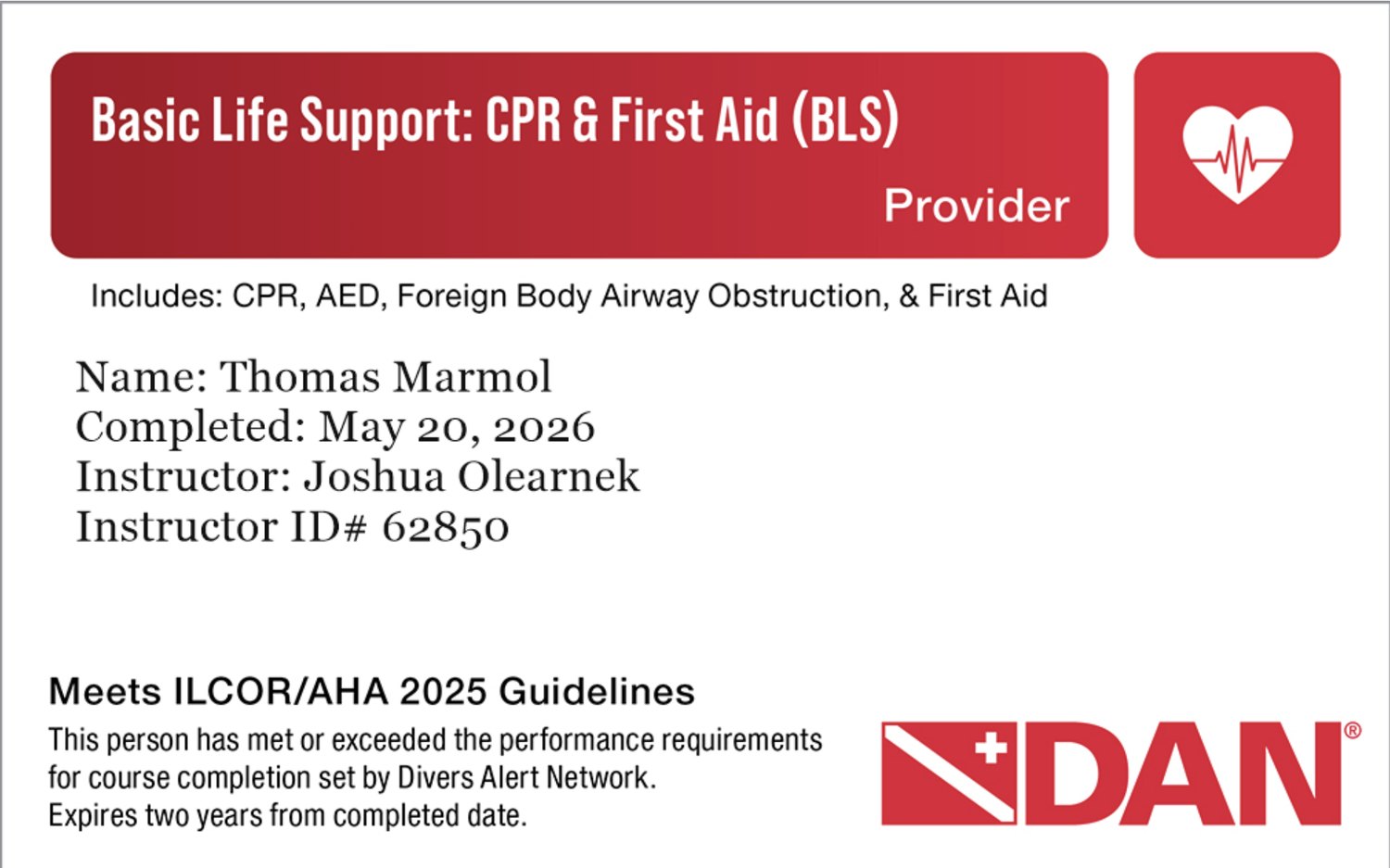
img/cert-cpr.jpgBasic Life Support: CPR and First Aid. Divers Alert Network · May 2026 · to May 2028

img/cert-food.jpgCertified Food Safety Manager. National Registry of Food Safety Professionals · Apr 2024 · no. 22055595

img/cert-master.jpgMaster Certification in Entrepreneurship. Certiport · May 2023 · to May 2028

img/cert-esb.jpgEntrepreneurship and Small Business. Certiport · Mar 2023 · to May 2028

img/cert-intuit.jpgIntuit Design for Delight Innovator. Intuit · May 2023

img/cert-adobe-ps.jpgAdobe Certified Professional, Photoshop. Adobe · May 2023 · lapsed May 2026
Scanned from the originals. Every entry in Table 1 has a plate.
Numbers are printed where the issuing body prints one.
5.Outside the record
Crew Talk in Section 2.3 exists because a man I work with could not tell me something, and I could not tell him. Everything else on this page is work. This part is not, and it is the part people actually ask about.
- Reading
- Most nights. On paper, not on a screen.
- Listening
- Trumpet. For the rhythm, and usually while relaxing.
- Still bad at
- Spanish. Four languages, and not the one I hear every working day. Section 2.3 is what I built instead of learning it faster, which is not the same as learning it.
- Languages
- English and Czech first. Slovak and Polish after them. The Czech is from home, not from a class.
- Where
- Key West. Two hundred metres of water in every direction is either the best thing about it or the worst, depending on the week.